
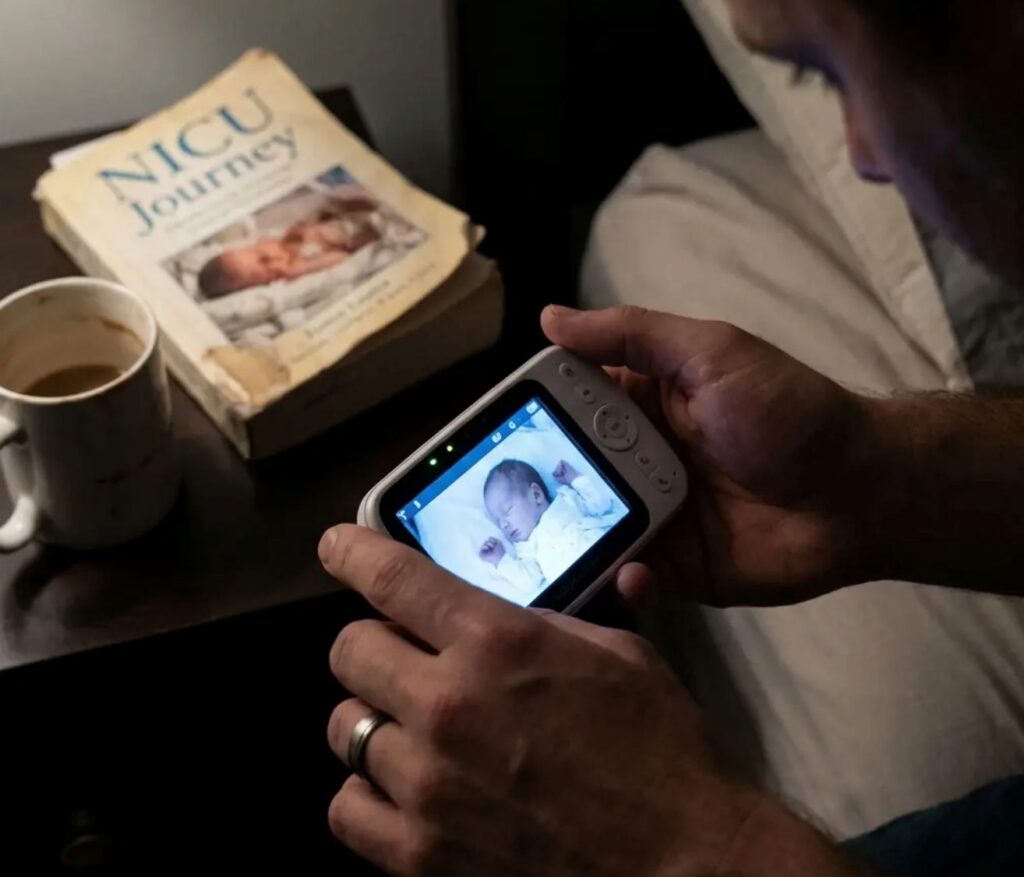
Nick Jonas just said out loud what most parents who’ve been through NICU hell keep locked away. His daughter Malti Marie—three and a half months in the NICU. Born at 1 pound, 11 ounces. Resuscitation. Intubation. Six blood transfusions. Him and Priyanka alternating 12-hour shifts during COVID, watching their tiny girl fight while other families around them did the same.
The story ends well. Malti’s healthy now. They’re grateful—deeply, genuinely grateful for the neonatal team and their daughter’s strength.
But here’s what nobody mentioned in that interview: what happens to you after you bring your baby home.
Because the research tells a completely different story than the one hospitals prep families for at discharge.
The Timeline Nobody Mentions
Anxiety among NICU parents drops to 26.3% between one month and one year after birth. Sounds encouraging, right?
Except post-traumatic stress stays at 27.1% more than one year after birth.
Years. These symptoms last for years. And nobody warns parents because PTSD takes at least a month to even diagnose. Families walk out of the hospital thinking “crisis over”—completely unaware that their mental health is going to unravel long after their babies come home.
The discharge conversation? All baby. Feeding schedules, medication times, follow-up appointments. What they don’t mention: up to 53% of mothers and 33% of fathers of preterm babies experience PTSD symptoms. Compare that to 20.7% of mothers and 7.2% of fathers in the regular postpartum population at one month.
The Gratitude Trap
When your baby survives, you’re supposed to feel grateful. And parents do.
But being grateful doesn’t make the trauma disappear.
Up to 20% of mothers with hospitalized infants experience depression—worse depression than mothers of healthy babies. About 35% of mothers and 24% of fathers experience Acute Stress Disorder within days of their baby being hospitalized.
The whole medical system runs on survival as the only metric. The nurses and doctors—people who genuinely care—say things like “at least they’re okay now.” They mean well. But it shuts down any space to say out loud that you’re still drowning.
You can be grateful your child survived and still be completely traumatized. Both things exist at the same time. The problem isn’t the parents—it’s that the healthcare system has no room for both to be true.
What Hypervigilance Actually Looks Like
In the NICU, hypervigilance kept your baby alive. You learned to read monitors, catch tiny changes in breathing, brace yourself every time a doctor walked toward you with That Face.
Once you’re home, that switch doesn’t just flip off.
Parents describe shooting awake at 2 AM in full panic, running to the bassinet to make sure the baby’s still breathing. That feeling of waiting for the other shoe to drop—like you can’t fully trust that you’re actually okay, that the crisis is actually over.
Maybe you don’t trust other caregivers. Maybe you can’t let your mom—who raised three kids—watch the baby for twenty minutes. That constant vigilance, that inability to let your guard down? It’s not because you’re broken or ungrateful.
It’s a trauma response that got activated in the NICU. And it needs to be treated like trauma—not dismissed as new parent nerves.
The Systemic Failure in Screening
Here’s what makes this worse: how sick your baby was doesn’t predict which parents will struggle the most with mental health afterward.
Without standard mental health screening, parents who need help get completely missed.
Everyone agrees postpartum mental health care matters. But actual widespread screening in NICUs? Still barely happening. Almost no studies even describe universal screening for NICU parents.
And timing matters. Parents should be screened early—1-2 weeks after admission, once the initial shock settles. Then again within 48 hours of discharge, because distress symptoms start showing up as early as two weeks postpartum, and they spike right before you take your baby home.
Discharge planning that actually connects mothers to community mental health support? Desperately needed. Currently non-existent for most families.
When Support Evaporates
Going from NICU to home is this intensely stressful shift. You lose your relationships with the care team, you lose the constant professional support, and suddenly you’re alone.
NICU parents describe coming home as “pervasive uncertainty”—constant worry about your child mixed with this crushing doubt about whether you can actually do this.
Our healthcare system is completely fragmented. Pediatric care focuses on the baby. Your care—if it exists at all—gets shoved into some separate adult system that doesn’t talk to anyone else.
A recent study found 56% of NICU families needed information, support, and close follow-up in the days after discharge. Of those families, 21% had mental health concerns after getting home.
There’s almost no guidance for extending the support that existed in the NICU beyond those doors. So there’s this massive gap where families need help the most.
What Actually Helps
Trauma-focused therapy shows increasing benefits for depression, anxiety, and PTSD from 1 to 6 months after starting. The effects build over time as you actually use the techniques at home—it’s not an immediate fix.
A cognitive behavioral therapy program designed specifically for parents of preemies helped reduce the harmful belief that your child is still medically fragile. This was the first study showing an intervention could actually lower parental perceptions of child vulnerability—which matters enormously for your child’s development.
Vulnerable Child Syndrome happens when you keep seeing your child as fragile even after they’ve fully recovered. Parents with PTSD struggle more with co-regulating their babies, which increases the risk of social and emotional problems for the child.
Untreated PTSD, depression, and anxiety last for years after NICU discharge. Beyond destroying your quality of life, unmanaged mental health impacts your ability to parent, damages your relationship with your child, and affects their neurodevelopment.
The Barriers You’ll Face
Mothers with public insurance visit the NICU less often and get screened for mental health at lower rates because of transportation problems, childcare issues, money, and almost no maternity leave.
You might not qualify for treatment at certain centers because you’re outpatient now. Finding a provider who takes your insurance or practices anywhere near you? Nearly impossible. There aren’t enough trained mental health professionals—period.
Even with insurance, getting coverage for mental health care is a fight.
What Should Be Standard
Every NICU should have standardized screening for parental depression, anxiety, and trauma. Screening should start at 14 days post-admission and be built into routine care—not optional.
Any positive screen should trigger an automatic mental health referral. In one program, about 27% of parents screened positive and got referred.
Effective screening programs spell out exactly which tool to use, who does the screening and follows up, when it happens, and how results get used. Successful programs have champions, full staff buy-in, and screening built into workflows that already exist.
Discharge planning should cover medical, physical, psychosocial, and mental health needs—for both baby and parents. Every family should be screened at NICU admission for social determinants of health and risk factors, with early referrals to community support and social work.
What You Can Do Now
If your baby’s in the NICU right now or just came home—listen: your mental health matters just as much as your baby’s medical care.
Ask your healthcare team about mental health screening. If they don’t offer it, ask directly. Use these exact words: “I need to be screened for postpartum depression, anxiety, and PTSD related to our NICU experience.”
Find other NICU parents. Connecting with people who’ve actually lived this creates healing that doctor’s offices can’t provide. These communities become your most trusted source for finding mental health providers who actually understand NICU trauma.
If you’re dealing with hypervigilance, intrusive thoughts, sleep disruption beyond normal newborn chaos, or you’re having trouble bonding with your baby—these are signs you’ve crossed from normal adjustment into something that needs support.
You’re not alone. What you’re feeling is a normal response to an abnormal situation. Your child surviving doesn’t erase what you went through—watching them struggle, being separated, feeling completely helpless.
The healthcare system should be handling this. Until it does, you need to fight for yourself with the same ferocity you fought for your baby in the NICU.
Your mental stability directly affects your ability to care for your NICU baby and any other kids in your family. Taking care of yourself isn’t selfish—it’s essential.
Resources:
Postpartum Support International Hotline: 1-800-944-4773
Text “HELP” to 800-944-4773 (English) or 971-203-7773 (Spanish)
For NICU-specific support, search for NICU parent support groups on Facebook or ask your hospital’s social work team for local resources.