Full Transcription: Holistic Care Through Integrative Medicine
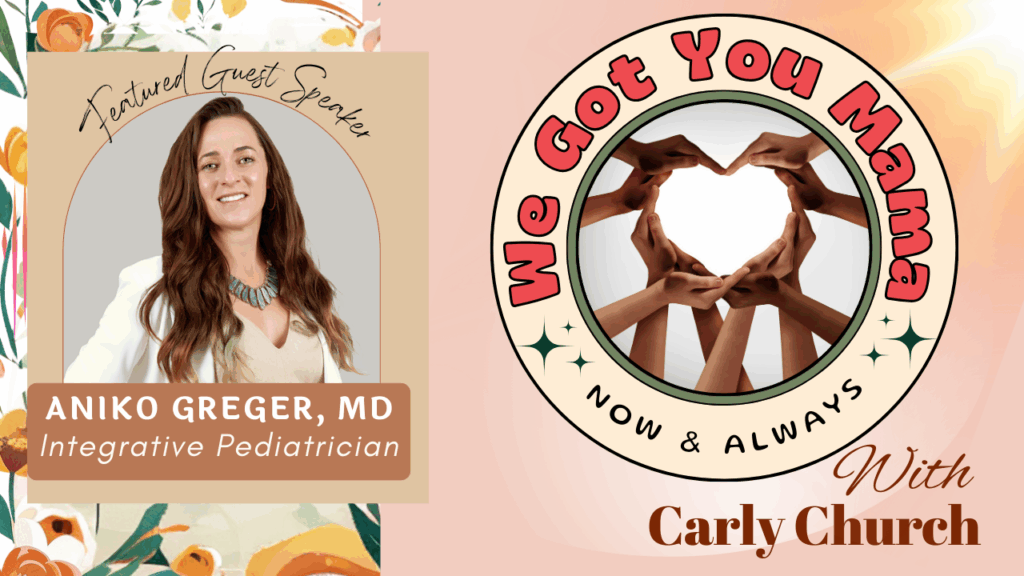
Welcome, welcome, welcome, welcome to the We Got You Mama Summit. Dr. Aniko Gregor. Welcome, welcome. Thank you so much for joining us. You are here joining us from Louisiana. Thanks for popping in, and I’m so excited to chat.
So a little bit about Dr. Aniko.
She is in the world of integrative medicine, her own path of healing led her into that space, and you are going to love hearing from her, her ideas, her what she produces within this, you know, this newish path that she went down as a pediatrician.
Creating Space Beyond the Traditional Medical Visit
And when we chatted last, we talked a lot about how, you know, parents didn’t feel comfortable or entitled to use that time because it was so quick of those pediatric visits, right? Like in and out, it’s about the baby. Baby didn’t get in weight. Okay, you need to do this. You need to do that.
And then you’re just, you know, their needs aren’t being met, and they’re the ones that are taking care of these babies. So what’s happening when the needs of the parent aren’t being met, right?
She is in the world of integrative medicine, her own path of healing led her into that space, and you are going to love hearing from her, her ideas, her what she produces within this, you know, this newish path that she went down as a pediatrician.
Creating Space Beyond the Traditional Medical Visit
I remember being kind of ushered out the door and like, “Oh yeah, well, okay, well, you’ll be fine. Here’s a bottle. Here’s some formula samples,” and like, “Just make sure she gains weight.” And I was like, “I don’t—I just thought I didn’t, you know.”
And I was very confused and lost, thinking like, “But that I have to rely on my doctor. I have to listen to what she says.” But also like, “I don’t—I didn’t—I don’t really want this path.”
And so we’ll let you launch into, you know, when things change for you with that second child.
From Pediatrician to Personal Awakening
But yeah, so I had my first child, and it was sort of that ignorance is bliss situation where it was my first pregnancy. Everything went swimmingly.
I did have a little of—obviously, I’m a pediatrician, so I have insight. And I was actually studying for my pediatric board exam while I was pregnant.
So I kind of needed to deal with myself that I was like, you know what, there are literally thousands and thousands of pages of things to worry about. I’m just not going to worry about anything.
Community as a Protective Factor
One of the things looking back that was really pivotal for me was that one of my best friends had a baby about a month before I had mine, and it was her second. And we really partnered together.
I didn’t realize how impactful it was at the time, but looking back it seems really clear to me that having that person that I could sort of live this with had a huge impact on my life.
And so then, you know, baby gets older, I go back to work, and then I had two miscarriages.
Mental Health, Loss, and the Postpartum Reality
I didn’t know at the time because I didn’t have my training in perinatal mental health, but it did put me at a higher risk for PMADs or peripartum mood and anxiety disorders.
And then I had the second. Similarly, it was a really good pregnancy, but I was really worried the whole time. I was really paralyzed with anxiety that I wasn’t communicating.
And then afterwards, we had some really big life changes, and I just spiraled. I had a really, really tough postpartum course, and I developed postpartum depression.
Asking for Help and Rebuilding Identity
It was really humbling. It was like a reckoning, you know, where you now have to face all the things, and you have to be the one asking for help.
Certainly, as a doctor and as a mom and as a woman, I was not used to asking for help, and I really, really needed it.
And then, of course, the pandemic happened, which had a huge impact on mental health just in general.
Discovering a Gap in Postpartum Support
People that I knew just kind of started calling me and being like, “Hey, like I just had a baby. I had these questions,” or, “I’m about to have a baby.”
And the conversation always really unfolded and opened up into this much larger arena of people needing community in this postpartum period.
And I found that not only did I really enjoy the work, but I also felt like, “Wow, people are falling through the cracks here.”
Integrative Medicine and Whole-System Care
So that’s when I started doing postpartum consulting. And eventually, I trained in peripartum mental health.
And so that’s how I ended up now practicing both integrative pediatrics and postpartum consulting.
But I will say you can’t really treat the baby without treating the mom and without really treating the family.
Rethinking Postpartum Healing and the Fourth Trimester
Western medicine focused a lot on survival, which is important, but postpartum is not such a high-acuity time.
We talk about the fourth trimester, and how traditional cultures understood the importance of rest, nourishment, and community.
All the things that baby needs, mom needs too.
The Sacred Nature of Postpartum Transformation
The postpartum period is this time of transformation where you are integrating pregnancy and birth into your identity.
This process doesn’t happen without support, and it doesn’t need to be rushed.
There’s no going back—there’s only going forward into a fuller, more powerful version of yourself.
The Power of Perceived and Actual Support
Community and support are pivotal for mental health in the postpartum period.
Even knowing support exists—having names, numbers, resources—can make a measurable difference.
Planning for support in the third trimester can set people up for success.
Healing Is Communal, Not Solo
Self-care tools are helpful, but real care is communal.
We need others to step in with their listening, their skills, and their presence.
When support flows both ways, it becomes energizing and sustaining.
Reclaiming Meaning, Ritual, and Wonder
Birth is still miraculous, even though it happens every day.
Ritual, nature, and pausing help reconnect people to the sacredness of the experience.
This is how meaning is preserved during a profound life transition.
Closing Reflections and How to Connect
Community is how the world changes—by naming what isn’t working and choosing something better.
If you’re seeking support, Dr. Aniko offers postpartum consulting virtually.
You can learn more at draniko.com or email info@draniko.com.